Tuesday, 29 January 2013

BACON'S SCRAMBLED STUDIO: FRANCIS & MARGARET


Francis Bacon's Studio, The Hugh Lane, Dublin
The article in The Australian Magazine told of the plans for the Margaret Olley studio to be relocated from her Federation home in Sydney to the art gallery near her birthplace in northern New South Wales, the Tweed River Art Gallery. She had left money in her will for this move to be funded. Just why the room could not remain insitu was not explained. It seemed odd that the movement of a place so cluttered could even be contemplated. What rationale, what strategy, is required for the precise relocation of the chaotic and ad hoc? Can something random be rationalized without changing its casual, 'everyday,' status - its inherent nonchalance? - see http://voussoirs.blogspot.com.au/2012/08/tweed-art-gallery-not-too-twee.html
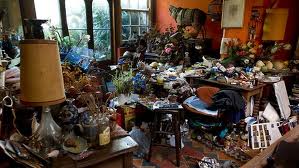
Margaret Olley's Sydney studio
Then there is the issue of light and vistas. Margaret Olley had often spoken of her much-loved workplace, pointing out the subtle variations in the natural lighting of her studio with the time of day. She had also told of the importance of her garden for the room, and of the significance of the views into it. She had frequently shown these glimpses in her paintings of her studio that explored the wonderful complexity of detail that surrounded her - literally. There is a photograph of her in her studio, sitting in a ceiling-high sea of chaos. Was the proposal to move all of this serious?


This was the artist's 'mess' that was going to be relocated. But how could the natural Sydney light and the temperate garden be transposed? There seemed to be a problem with this idea that wanted to move thousands of items some nine hundred kilometres north and replace them in their identical shambles of a relationship, in a precise space, place and pre-determined, 'identical' organisation, all with a character and presence that tries to match that of the original muddle. Is there an issue with provenance here? Can the integrity of a studio be taken holus-bolus and put elsewhere for public display without it becoming something else - perhaps another remote 'art' object itself; or worse, a copy or reproduction of the original? Does a studio hold real sense only for things silently and secretly intimate and personal? Does a studio have any relationship with output? Is staring into an artist's workplace like looking at the artist in underclothes, or in the shower? Is this just a voyeuristic occasion?


The report noted that architect Bud Brannigan had travelled to Dublin to confer with the curator of the Dublin City Gallery, The Hugh Lane. This gallery had Francis Bacon's studio on display. It was said to have many more items in it than the Margaret Olley studio that, ironically, was being itemised by her friend and Brisbane gallery owner, Philip Bacon - (no relationship). What is the world coming to when studios are compared in such a quantitative manner? One wonders why the different areas and other dimensions were not mentioned! It is this attitude, approach, and the curatorial rigour required, that seems to intrude into and distort the very best intentions in the concept of relocation that appears to want to preserve something meaningful of the artist - the aura of the source and sorcery of the mysticism of creativity as real place and factual daily detail. Still, the idea intrigued. Dublin had to be visited in order to see the results of the Bacon move. Just what should one expect? What might the experience be?

Dublin proved to be an enigma. One gets a feeling for a place through its stories and published images. Dublin has a marvelous reputation - pubs, grand graphics, sweet names, genius, Guinness, doors, bridges, Wilde, Behan and Joyce, and more: more Guinness. It was 'flavoursome' indeed. Yet the arrival was as boring as that at any airport, perhaps a little more perplexing in its Irish way. The sprawling buildings and the usual processing of passengers offered no revelations. Queues, patience, time, discomfort and frustration all mix to mess with the fatigue of distance and time. Eventually one gets clear of all of this testing and checking only to discover that, even with the delay of immigration, the bags had not been delivered to the endless conveyor belt. This wait only made the appearance of one's luggage a greater delight. All still in one piece too! Free at last after not being challenged by Customs. Moving into the open space and the chilled, sharp air of Ireland, one was left with a new problem: where were the buses? Airports remain a constant source of frustration.

Signage was of little assistance. Once one had exercised some creative interpretations, the guessed direction did reveal something that looked like a likely bus stop in the distance. On closer inspection it turned out to be so. A bus arrived: not ours. But where was the one we had booked? "That's over by the church," said the attractive lyrical accent accompanied by a matching gesture that was directed at the distance. A five-minute struggle with bags over kerbs and ragged pavements that aimed for the crucifix, finally revealed a parking space full of buses. It was strange to see these giants hiding behind a church, all neatly arrayed. But what was a church doing in the middle of airport parking and roads? Why were these buses so isolated? This was Ireland, so why worry? Its reputation for the obscurely rational irrational revealed in most Irish jokes remained intact: "In which direction is the . . ?" "Oh, I wouldn't go that way." "Why are these two clocks in this railway station telling two different times?" "Why have two clocks telling the same time?" Relief came when our bus arrived, on time. We could sit and relax at last, and enjoy the trip to our guesthouse in central Dublin.


After settling in, we decided to explore the city. We stepped out into Talbot Street and headed for O'Connor Street - the spire. What was the aspiration, the inspiration, for this cliché landmark? What significance for place did this mighty gesture hold? It seemed strange, but the eye kept returning to it to gauge its reality. It was high; it was fine - so fine; so high; really fine; really high! It was quite wonderful in a strange way that made it feel something unbelievably alien but exciting, like finding a needle in a haystack.
 Haystack seemed a good analogy for Dublin at this time of day. Late Sunday and it was still just a messy crowded chaos of people walking willy-nilly while shopping in stores that are everywhere else too. This was not the Dublin we envisaged. So we strolled to the Liffey hoping for a revelation - those bridges, layer after perspective layer reaching over a twisting gleam fringed with classical Georgian buildings. We were greeted with the mud, stains and trash that are revealed by low tides, and crowds moving over one pretty structure somewhat mindlessly like soldier ants. Why could I not see the other bridges? Where were the grand buildings. Those before us were the typical flat facades of a bland city - warehouses. The only enjoyable characteristics were their colours and their reflections in the muddy wash that seemed to wallow in this game with the ordinary, creating wonderful ‘impressionistic’ images.


We decided to retreat to the pub. An Irish pub in Ireland! This should be astonishing. Sadly it seems that the fake venues have manipulated the clichés so much that the real thing becomes a disappointment. There was no music or song, just the noise from the television set that was showing the match of the day live. It was the centre of attention. Even the barman had to be prompted to serve us. But there was Guinness. Ah! Real Guinness at last! Made with Dublin water. Gosh, there was not even that wonderful difference that folk dream of, even eulogise - but it was still good, and helped to ease the fatigued body and to encourage the forgetting of the frustrating thoughts about this disappointing dump, Dublin. Was it all due to our tortured time zones? Another pint, a meal and bed ended the day.

Dublin had always been on the list of 'where to go' because of one book - Kells. Trinity College has had the Book of Kells on display for years. Hours have been spent drooling over the details of the Thames & Hudson facsimile edition; so seeing the real thing was something that had been anticipated for years. Just what did this vellum look like; feel like? Was the book still turned page by page every day? We set out the next morning for Trinity College. It is interesting how one can map a place by exploring Google Earth and Maps, and Streetview. We knew where to go and how to get there without asking. It was directly over the bridge seen yesterday. So we headed for the spire. We had not noticed before, but the lower portion of the spire, that part that was as tall as the adjacent buildings, was a patchwork of mirrored splotches in the sea of satin that continued up beyond to the extreme top of the needle point. It was not only the height of this structure that dazzled belief, but also it supremely elegant tapering to nothing - and it remained stable and vertical too.


Turning left took us along O'Connor Street to the Halfpenny Bridge and onto a grand boundary fence that could only be that of Trinity College. Following this bold edge led us to the iconic central meeting place of Dublin - the main entrance of Trinity College off College Green - a space framed by the massive Bank of Ireland. Was a building of this astonishing scale really built as a bank? It was only later in the day that it was discovered that this was the first parliament house. Entering Trinity through a modest, central doorway in an old timber screen, took us over hexagonal timber setts and along a short vaulted passage into academic courtyards - KEEP OFF THE GRASS: NO BICYCLES. The axial alignments took the eye to the left and right and into the distance under a central Gothic revival tower. Trinity library was to the right.
Trinity fence

Entry to Trinity College from College Green
Bank of Ireland Centre, College Green, Dublin
 Trinity College, Dublin
The entry was through the shop, a cheeky move that is usually left for the exit. This commercialism predicted the exuberant display about various significant books - their histories, details, stories and making. Only after passing through this informative maze was the real book revealed - the real Kells completely sealed in a Chubb display case, safe, secure and distant. No page turning here! The gallery 'guard' was dozing in the corner. He had nothing to do when there was this quality of enclosure. He didn't even seem to worry about enforcing the NO PHOTOGRAPHY signage as the American clicked away undisturbed.

So this was Kells. Simply stunning: dirtier than the facsimile that presented itself on perfect gloss paper and in precise new inks. It is always interesting to see the real word with its textured scratches, muddy spills, decaying splotches and messy grubbiness - yet so fine; so astonishingly delicate; so unbelievably beautiful. Returning to the maze, the main item of interest was the making. Velum. Did the quill really make such an annoying scratching noise when transcribing with such apparent fluency? Binding involved stitching with linen thread. I never knew that the ridges on the spines of old books were functional and not decorative, being the cords which the velum pages were stitched to, over which the calf skin covering had been dressed. Like most superceded functional necessities, it seems that this moulding of the spine remained as a decorative forming when the binding technique had developed alternative methods of construction.


One can only be amazed enough for a limited time before it becomes a self conscious re-enactment, so we exited up the newer concrete steps to the old library above. What a bonus. A double-height vault with walls of book spines on each side, all accessed by old, flimsy, wooden ladders. It was the classic vision of book storage, complete with lines of marble busts marking each stack with an icon of learning. This array was all behind the maroon rope barriers that directed one down stairs and back to the shop. A double whammy!

Saint Stephen's Green
Days in Dublin only became more relaxing and enriching. Saint Stephen's Green became the place for retreat after walking kilometers, discovering the classic buildings, the doors, the Pugin church, (not even indicated on the map!), the canal, the other bridges, and more. It was only on the last day that there was time to seek out the Bacon studio. This had not been researched in any detail, so the city was explored, gauging direction by nose alone - always an interesting process of discovery. Go north and east, I think.

The Hugh Lane, Dublin
Discovering the destination without any detours is always very satisfying. The light was fading as the day closed and the students relaxed after their excursion. The Hugh Lane Gallery stairs were layered with frollicking uniforms framing the entry like Laocoon groupings. It must have been the end of a school excursion. The information desk advised that there was no charge and happily passed over a map of the gallery that showed the location of the Bacon studio. After moving in through the main doors, the gallery revealed itself as a bright, white set of modest spaces strung together with an axial arrangement of doors that pierced the core of each with a set of beautifully and richly detailed timber architraves, repeated identically one after the other into the distance, on and on until they terminated at a glass sliding door - the Bacon area.

The various white galleries had differing shapes and proportions and other axial extensions. Some had natural lighting. Each displayed a nicely modest number of paintings in an arrangement that gave the small place some sense of grand scale without being overbearing. The glass door slid open automatically on approach, allowing the blare of the Bacon audio to spread into the other quieter gallery areas. Up some stairs one discovered folk aligned on a bench, watching Malvern Bragg interview Francis Bacon - a very young Bragg and Bacon. It was, as is usual for Bragg, a good interview. It was only Bragg that the dying Dennis Potter would let interview him in his last days. Bragg's sensitivity is shown in his foreword to the published text when he tells how, after the event, he left the studio and walked out into a dark, late London and wept. Here we saw Bragg asking his usual probing ordinary questions without any judgement, only a genuine interest. "Do you draw and sketch before painting?" "No," replied Bacon, "as this would only mean that I would be painting a drawing. I like the immediacy of paint on canvas."

This point was again made when Bragg asked Bacon more about why he used the reverse side - Bragg called it "the wrong side" - of the canvas. Bacon said that he had discovered quite by accident that the reverse side of the canvas was coarser than the front and took the paint more aggressively quickly. It did not allow for any retouching. When Bragg asked what Bacon did to canvases that he was unhappy with, Bacon said to a disbelieving Bragg that he destroyed them. "Destroy them?" "Yes, I cut them up."


On entering the studio, Bragg was surprised, as the walls were all daubed in paint. "I test out my colours on the walls," explained Bacon. And so the interview went on. When asked about his creative process, Bacon fumbled for words and then admitted that he had thought about this before the interview, and asked if it would be all right for him to read from the notes he had scribbled on a piece of paper in his pocket. Bragg agreed, and a self-conscious Bacon read his own words, putting some doubt on his claims that he prefers the risk of immediacy – the challenge of the moment.


After watching the endless loop of video to where I had started, I wandered around looking for the studio. There was a display in a couple of glass benches that held some Baconalia: books of the era; early photographs; some images of his early sources; and the like. Still, no studio. Then a recess in a wall was noticed. It was the size for one person and it was occupied. What was this? A toilet; a confessional? When vacated, I positioned myself in this nook and found myself framed in glass in the open door of the studio looking at all the mess and mangle of a mysteriously silent but real still life. It seemed that Bacon painted with Dulux Matt Vinyl paint. The brushes were so numerous that one sensed that he might use them just once before they hardened into their final form seen here as more than several sets sprawling everywhere.

What was one to make of this? One had been told that the room linings and the contents were all original, just as Bacon had left them. So what? One was left stranded on a point. One could not even see behind the door on the right. It was an odd feeling of exclusion - KEEP OUT; LOOK ONLY, a little like the Trinity grass. How long was one to stay? What was one to look at, out of so much of a mess? The situation did little more than emphasise one's isolation in the world where one was an outsider - the observer only.
 
Stepping out and around to look for other vantage points took one the full circle without any revelation, so off again. Two peep holes were discovered, one directed to a few brushes, the other to a swatch of paint smudged on the wall. So what was one to do with these chosen details? Further around, two windows at the exterior gallery floor level were discovered. These allowed one to look down into the studio as a stalker might purve on his subject. It was an awkward situation, more alienating than the vertical glass coffin in the doorway. One felt exposed here, extremely self-conscious.


So that was it - Bacon's studio. Was the effort worth it? The effort to get there was because it opened up more of Dublin as well as the gallery, but the task of shipping this space and its components and reassembling them - was this effort worth it? Many questions arise on this issue. The studio has newspapers scattered around the floor and piles of books tumbling down onto paint tins and brushes. A couple of canvases lean against a paint-smudged wall. Two easels stand as icons in the clutter. Does one see this as a composition, for it must have been so perceived for the place and its pieces to be repositioned? Does this awareness change even simple pieces of paper that have been strewn about in an unselfconscious manner? This is the core question. Can anything scattered so unself-consciously that has been relocated self-consciously remain the same?

 It seems to me, no. So what is this studio other than a display recreated for visitors - tourists - to look at: an attraction? Is there any more meaning in this piece of theatre than this: the making of a place to entice inquisitive numbers of people seeking an 'interesting' emotional, even a pseudo-educational, diversion? - see http://springbrooklocale.blogspot.com.au/2012/06/who-or-what-is-tourist.html

Provenance is held only in each small part that has been stripped away from its context and repositioned into its newly planned and documented location. One can imagine the process: do you think that this rag should be crumpled differently? Does this book need to be at a different angle? Should we move the brushes a little to the left? . . . etc. How one might cope with the continuing aging of the pieces is another issue. Here the conservation conversation might be: Should we replace the rusting, leaking tin of paint with something that might have been as Francis had left it? . . . etc.
 If there is any concern with this analysis, then one needs to ask how a copy of an original differs from the original. Just what is the difference between the original Picasso and the perfect copy? The answer is none if one considers the studio relevant, because the first was a response to Bacon's activities; the second, a reconstructed copy 'after Bacon.' The difference between the original studio insitu and the relocated one is immense, both intellectually and physically - psychically too. The Dublin Bacon studio has a rich shambles inside, but outside is all pure white, stainless steel and Pirelli studded rubber. The attempt to show the memorable steep stair with the rope rail access that led to Bacon's loft studio becomes a framed view of what one presumes to be the original stair now relocated, viewed through a glazed floor panel outside the vertical glass coffin viewing box. This seems to sum up the problem of relocation and new context. There is no way that the stair can be experienced in relation to the studio as Bacon would have sensed it. It is an item behind glass located in the slick and smart environment of the white gallery - an exhibit. It seems that the importance of this Dublin-located studio is the display of Baconesque relics in the same manner as cathedrals display parts of saints. This is hagiography at its most blatant.
So what hope is there for the Olley studio? This will really be no different. All one can say is that it is being done, and should be, because Margaret Olley wanted it to be. It will just become a tourist attraction for gallery visitors to gawk at. In this circumstance, to reverse the cliché, more is less. Put simply, eggshells, for this is all studios are - places in which subtle things are lovingly created - cannot be put back together again, in the same way as eggs cannot be unscrambled. Humpty Dumpty proved this. It should have been known. The rambled mess should have just been left alone if we wanted to keep something with even the slightest sense of substance and meaning. Both Bacon's have a problem - Francis and Margaret’s.


* * * * * * *

 There is a postscript to the visit to the Bacon studio. On leaving the gallery spaces, one is directed through the retail shop - where else? Here I searched out a couple of images of the Bacon studio as photography was not allowed in the gallery. Looking at the postcards, my eye was caught by some Bacon sketches. But didn't Bacon say that he never sketched, only painted with the brash immediacy of wet paint on the unique challenge of wrong side of the canvas? These two postcards showed Bacon exploring ideas and set outs as drawings. Didn't I see a tee square in his studio? One does not use a tee square with immediacy. It seems that Mr. Bacon has been rather loose with the truth.# Was he just concerned only with his image - creator of the instantly meaningful brushmark? It seems so. He was particular with the words he wanted to use to describe his approach and chose to read them. This only adds a greater enigma to his studio. Can the mess really be an 'honest' mess? Doubt has to be raised about this. It is too easy to suppose that it might be. There is a certain romance in the idea that art can arise from chaos: mystery from mess made by the rebel nonconformist who holds the power of vision that sees things differently. One has only to look at Margaret Olley's paintings and her carefully assembled subjects to discover how self-conscious her collected still life collage - her studio 'mess' - really is. The slightly disturbing matter is that Miss Olley kept her subjects exactly as she had depicted them for years after they had been painted. Is this phobia the driving force behind keeping her studio as a relic? Has the Bacon studio a similar problem, perhaps rooted in someone else's phobia?
A further problem with such quirky promotional displays of iconic artists' workplaces is that messiness becomes equated with desirable artistic outcome, encouraging the charlatan to create a mess and act differently to give the impression of what is hoped will only be seen as an artistic genius. It seems that the only good that will come out of such exhibits is an increase in visitor numbers. The end result is the perpetuation of the idea of art as exhibitionism. In this regard, Coomaraswamy's question: 'Why exhibit works of art?' needs to be seriously considered.


 * * * * * * *

Thoughts linger on this issue. It is very complex. Consider Bacon's little room located in a dimming Dublin. As it was approached from the street, it was the artificial lighting that highlighted the art gallery, made it a beacon that welcomed its discovery. On entering the gallery from the cool, outer dark, the bright, white light of the gallery spaces was truly invigorating. The movement into the Bacon display area was matched with a drop in lighting levels - a softening of the light. This was for the video presentation. Lighting levels dropped further as one explored the outer zones of this space that were the fringe areas around the studio display. Down lighting was part of this context for the studio, bearing no relationship with the original place or location of the workroom, just with this gallery. Peeking into the studio, one saw a space not only frozen in time, but also fixed in light. The artificial lighting of this interior was as false as the display itself: there was no natural variation here, no subtle changes that told of outer events.


Now it occurs to me that this display is nothing other than a Victorian peep show, a diorama, but not as exciting, mysterious, or beguiling. In the same manner, it has all of the characteristics of the old 3D photographic viewer - put in the twin image, hold it up to the eyes and behold the Bacon studio in all of the identical remote glory that can be seen through the looking glass of this tiny spec of a display in Dublin city: one context is a gallery; the other the armchair in the lounge where the imagination can be teased with visions of tourist destinations in the comfort of one's home. Well, it might as well have been a piece of this personal luxury, given the circumstances of the display and the singularity of the main viewing point. It may have been better.


And Dublin? As time passes and distance extends, the memories enrich. Is Dublin built from the stuff of longing?


P.S.
 In a report by in The Sydney Morning Herald of 1 June 2013, Treasures of Olley's life go under the hammer, Andrew Hornery writes about the items that will not be required for the relocated studio:

'The goods and chattels are items from the artist's home that will not be part of the re-creation of her famed painting rooms at the Tweed River Art Gallery.' see http://m.smh.com.au/lifestyle/private-sydney/treasures-of-olleys-life-go-under-the-hammer-20130531-2nh7m.html

So it seems that the studio is a reconstruction of a set of carefully selected items only - a new creation for tourism. The unwanted items are to be auctioned. What criteria have been used to make the selections? What part of Olley's life will be discarded? Are we to see only Bacon's vision of Olley? What 'treasures' are being denied to the public in this display? 

Is it ever a good idea to relocate and display the intimacies of one's life and pretend that nothnig has changed? I recall how, even when the location had not changed, Wordsworth's and Beatrix Potter's world had been santisied. One saw 'everything' - execept the privy, and, upon further reflection, much more too. Why was the lock of hair there; the suit of clothes: to suggest something personal an complete? One saw only a curated vision: a created vision shaped by others. One can suppose that there is little wrong with this as long everyone knows it is simple theatre for tourism, nothing more. How bored must we become to endure these fantasies?

#
NOTE
29 October 2019

On Bacon’s statement concerning the “immediacy of wet paint,” it is interesting to read the assessment of those close to him in Jon Lys Turner The Visitors’ Book In Francis Bacon’s Shadow: The Lives of Richard Chopping and Denis Wirth-Miller Constable 2017, page 38:
Bacon was an unreliable and mythologizing source when it came to the biographical details of his own life.

Perhaps one can say the same about his comments on his own work too?

Monday, 28 January 2013

FLOOD PLANNING


When will authorities take responsibility for their actions? Why should any development - old or new - have to put up with repeated flooding? In a country that is so managed with endless regulations that cover nearly every possible activity and action - one is not allowed to change a tap washer or an electrical plug, let alone build, without involving regulated specialists - why are houses and businesses still being flooded? It is not as though the world is short of town planners or hydrological experts. When we have so many trained professionals and tradesmen who are licensed by law to undertake specific activities that are denied to others - like planners, architects, plumbers, electricians and builders - one has to wonder why developed areas are subjected to repeated flooding. The proposition is that these areas should never have been developed. One can understand that older times may have had different perceptions, but today we know - either by research or by reality - that places are flood-prone. With this knowledge, one wonders why there is not immediate activity to stop development in these regions and to start a buyback scheme that can return these zones into the flood plains/areas that they are. Water will go where is wants to, where it has to, when it wants to, irrespective of political games.


The simple question is: when will authorities take responsibility for their decisions, and even the lack of them? Why do they continue with their spin to allow anything to occur even in face of the facts that spell out differences. Even a simple car parking matter can never be accepted by local government, (the Brisbane City Council), in spite of the geometry and mathematics highlighting the impossibly of the arrangement. I can recall a CEO at the Gold Coast who put forward the concept that the flood plains in the region should never be developed for housing. He was relieved of his position. He was also reportedly threatened to be sued by the company that wanted to develop these areas. Now, with a large area of Queensland and northern New South Wales flooding as this is being typed - 10:00am, Monday 28 January 2013, after a night of raging wind and rain at the Gold Coast in Queensland - the support for the development of flood plains seems foolish: ignorant. Yet the arguments for this action were supported with 'scientific' facts to prove that housing in these areas was, (is? - have things changed?), a sensible possibility. One can even envisage a future where support for these developments will again be strong in some authorities. Why? Why on earth must this be so?


There is a conscious inactivity and self-evident unwillingness to attend to these potential impacts of disasters by governments, until they occur. Governments seem to want to force others to cover the costs of repairs for the results of their decisions, all while continuing to refuse to act to prevent their occurrence and recurrence. Already in this 2013 flood, that was promoted as not being as bad as the flood of 2011 - this seems to be wrong in some districts - the Queensland government is asking for public donations for its flood appeal; and the Federal government has, subsequent to the 2011 flood, forced insurance companies to cover everyone for floods, seemingly irrespective of the risk that usually determines the commercial response. The proposition was that insurers were being unfair – discriminating: unlike governments? What is rarely seen is a government taking responsibility for its actions. It is not as though folk have just moved in and built their homes and businesses in these locations without anyone knowing. Governments have approved these developments. They have colluded with developers to have housing/businesses constructed in flood-prone areas. All excuses have been used in the past to support this activity: "Science; don't you greenies understand? Go away. We'll do what we want." It is a retort that is frequently given to those who try to point out the problems with government decisions and indecisions.

Gosh, areas that were flooded in Brisbane in 1974, have subsequently been developed. The argument has been that the Wivenhoe Dam has changed flood levels for Brisbane, making land that was flooded apparently available for development. This fantasy was given such credence that those professionals who knew otherwise - that there was a significant catchment below the dam that was a concern, (and turned out to be one) - were apparently scared to tell the politicians the facts. It took the flood of 2011 to bring out the truth. Here another 12,000 more properties than in 1974 were inundated - see http://voussoirs.blogspot.com.au/2011/02/what-flood-level.html  And what has government done about this? Only whinge that insurers are not pulling their weight, and enforcing changes. What is needed is sensible planning - rigour.


Governments need to clearly identify problem areas and begin a buyback, so that natural flood plains/areas once more become just this: natural spillways for excess water. Pressures from developers to open up low areas for their profit-making need to be resisted. The riverside land that was reportedly given to a developer by the Queensland government for the price of the Pat Rafter Tennis Centre at Tennyson in Brisbane - no wonder the public spaces are so mean - was known to flood: and the new developments did. The flooding has put a stop to completing the planned construction of this high-rise dream. The developer apparently carried out remedial work on those apartments that went under, but how would one feel as an owner of such a property? Will the company be asking for some of the tennis centre back?

Politicians rely on short memories. Sadly rigour is never a part of planning for futures that seems to hinge on spin - that devised by the conjunction of politicians and developers for political or personal profit/gain. The call for 'objections' on development applications has become pure farce. Just what goes on behind closed doors remains unknown, but it has been seen at one time in the Gold Coast City Council how one approving planner was brazen enough to have his name declared in the submission to be reviewed/approved by him as a consultant/advisor planner. It may now appear unbelievable, but it was so. This planner was not sacked, merely removed to manage another planning division. Then there were the repeated reports on how agreements were (are?) being made between developers, councillors and planners even before any application was (is?) lodged – all with the certainty of approval! It appears that there was (is?) never any doubt as to the outcome. One has to place this circumstance in context - this is the same local authority that took exception to the proposition that flood plains should never be developed.


Until authorities take a rigorous stance on development with enforceable town plans that can define, describe and deliver carefully determined outcomes, we will have more and more flooded properties - see http://springbrooklocale.blogspot.com.au/2012/10/why-bother-with-town-plans.html  When town plans are so flexible and variable, allowing every possibility to be a reality at the whim of any person, developer, councillor or council, then disastrous outcomes will be repeated into futures at an escalating rate. And as long as governments refuse to take responsibility for their actions and in actions, and for those of others before them, then floods and disasters will be recurring. Action is needed for future planning that defines denials and repossessions - areas that must not be developed, left to nature, and areas that need to be returned to nature. It also has to include areas that are so environmentally significant that they must be retained and enriched with complementary management – left as nature.


The future does not look good when the current Queensland Government is unable to maintain any rigorous control of existing National Parks, being keen to open them up to all and sundry for whatever. In the same manner the local Council has councillors who are careless about managing futures, allowing anything that can be considered 'growth' to be promoted as sensible and desirable. It has been the perception that growth in any manner is good, that appears to have allowed for all of the stupid decisions, like developing flood plains and a reluctance to manage traffic on roads - see http://springbrooklocale.blogspot.com.au/2012/07/street-character.html - to be seen as being reasonable. What is now needed is a backtracking to reverse the outcomes of these activities and inactivities: admission and appropriate remedial action.

Will we get this? Never. Governments know best and never own up. There is always the classic Howard ‘non-core promise’ to fall back on. Just call for flood donations and for insurers to cover all of the results of silly decisions. Governments seem to have some of that "She'll be right" attitude that some "On ya" Aussies have. One resident - ‘a bloke’ - in Bundaberg was delighted with the flood waters. He told the reporter that he "Just loved them (the flood waters)"; that he "Looked forward to this (the flood waters)", as he waded through knee-deep muddy swirls to get to the pub - the true bronzed Aussie fool - even while all authorities were telling everyone to keep out of the flood water. Like this fellow, governments always know best. They'll do what they want irrespective of the facts - "On ya!": see http://voussoirs.blogspot.com.au/2012/08/notes-on-development-application.html

What can one say? Such is life in Australia: a country that burns in one region and floods in another while developers reign and governments 'grow,' worrying more about their own futures than anything else and anyone else. Everything will be OK - just keep the beer flowing: "She'll be right." A report on the television station that is covering the present flood situation, 'minute by minute,' has just noted with some pride that the 'Breaky Creek' pub is still serving beer, even with rising waters surrounding it. What chance is there for better planning in Queensland - in Australia - when this is seen as the ideal? Who would want to lose this opportunity? There is no need for change!


"This State will rise to the occasion," said Premier Newman, 2:00m 28 Jan 2013, on the latest 'minute by minute' update. The cliché cry is, "We are Queenslanders. We'll pull thru." It is a real shame that platitudes just keep getting repeated when no other action is taken to prevent this nonsense in planning. Why will governments not take advice? One can predict, in the same manner as one can with other development approvals, that development in low areas will continue to be approved. It will continue to be supported with the argument that it has been 'scientifically' designed to 'world class' standards so that the proposals will never, ever flood - until . . . well, until we get that totally 'unpredictable,' never-before- experienced, storm of the century – the millennium. "Who would have known?" Well, it seems, no government.
See also related blogs:

Monday, 21 January 2013

DUBLIN SIGNS

The message that is given by a sign and its graphic diagrams needs to be clear, with an ease of reading appropriate to circumstance. The sign that tells of restrictions on dog defecations in Dublin is immediately understood, even with the language barrier.


However, the traffic sign that advises on safe head heights and optional routes remains a puzzle even to the static eye. Just what a passing motorist would  make of this scattering of information as the vehicle moves on in the traffic flow, remains unclear. Decyphering messages of such importance needs a graphic rendering that is as instantly understood as that designed for dog owners, where, ironically, immediacy is not that critical. Well, it may not be.

PAIRS 8 - CONVENTIONAL INSPIRATION?

The Convention Centre, Dublin  Kevin Roche  -  Liffey elevation
Only the communication tower seems to be missing!


The toilet brush holder, Celtic Inn, Dublin

Links to other PAIRS:


CALDER IN SYDNEY


Alexander Calder is known not only for his delightful mobiles that play with colour, form, balance and breeze, but also for his stabiles. Harry Seidler commissioned Calder to make a stabile for his Australia Square development in Sydney that was completed in 1967. The black sheets of arcing steel bolted together to create this scultpure missed the opportunity to bridge the public footpath space and so engage all passersby in its delight. Instead, it is sited within the propery boundary of the development that is paved open space and does allow for some limited public participation - for Calder's sculpture to be observed 'aesthetically' as an artwork. The development is, after all, inspired Modernism.


The sculpture is looking as good as it did on the day of its installation, apart from the nelgect of its holding down bolts that are showing their 45 years of age. Astonishingly, the base plates show rusting holes where once there were bolts and nuts. Three bolts remain where once there were ten! Bolt details higher in the piece still mark out their precise pretty patterns without any sign of decay. Unfortunately, the voids in the base plates give one the feeling that this stabile might soon become a mobile if it is allowed to continue to deteriorate.


Tuesday, 6 November 2012

EXTRAORDINARY YE MEN!


I wondered at the Victorian quality of the evening - Wednesday, 15th November 2000. That formal Brontesque hairstyle hovering behind the misty glow of the lectern was not the only image to elicit such a romantic recall. The subject was Yemen. That extraordinary place with extraordinary landscape and extraordinary architecture was being introduced to an awed audience by an individual described by Professor Holden as an extraordinary lady with extraordinary skills. In all it was to be an extraordinary evening. And that is why it felt Victorian - or as one might have thought such an evening could have been experienced over one hundred years ago. It was a night abuzz with the expectations of the revelation of unknown delights: a true extravaganza.

Just imagine Carter showing slides of Egypt; of Woolley with his illustrated treasures of Ur. Once these were the unknown places of this world where the classic English traveller would meander with exuberant Britishness - an odd mixture of cheek and respect; of the brash and the sensitive. Tibet and China were once such mystery places too; and the Hindu Kush. These classic, learned, intrepid travellers can be imagined returning to London and being invited to present on an evening at The Royal Geographical Society where the unimaginable wonders of these hidden cultures could be revealed to amazed eyes. So the evening felt Victorian, where an encyclopedic delight in learning of new differences was the core of attention and expectations.

But this Yemen evening was in Brisbane at the Royal Australian Institute of Architects rooms in 2000. Professor Jennifer Taylor was presenting a talk on her recent trip to this remote place introduced as the last (one of) place where ancient culture and society remains alive in cities that were established in pre-biblical times by Biblical names. A relative of Noah was said to have been involved in this place with landscape appropriately - the flood - ripped apart by ancient riverbeds. There was once much water here, but not now.

The maps illustrated locations of names never previously heard of, while the slides flipped through amazing images of multistorey mud that looked like something else much more controlled. Fringed lime-white decorative mud passed into multicoloured facade details that looked crisply surreal and clear like a Jeffrey Smart painting. The beautiful illustrations were accompanied by a read text that was expanded with asides from the traveller – “we did…; it was; then we  ;etc.”

The evening presentation, precisely an hour's duration, always seemed that it might be more than a travel chat, but it retreated into this easy, lazy format. The promotional material, (complete with the formal Registration Form and cash payment), suggested the session was to offer much more than a traveller’s reverie, but it really was just a matter of look at this – “how it lives with the landscape; organic; at one; amazing; beautiful; stunning; etc.” And this became a concern.


This was the other reason that gave the evening its Victorian touch. These cultural delights were treated as aesthetic wonders just as the Victorians might have viewed them. There was no effort to try to understand the whole and its parts as those that made them might have seen them. Those attending that night were encouraged to look at these wondrous things as though they were indeed works of Jeffrey Smart - just self-conscious, composed, aesthetic things to delight the eclectic modern eye, nothing more. We were asked by way of the commentary to see these things alone in our world with our eyes only: WOW!

That the question about food elicited such a response of horror was odd. One felt that the real Victorians might have been a little more tolerant of impossibly different food. But how can food be separated from form? This circumstance only highlighted the position that saw only the difference we were invited to gaze at. No mosque was isolated for discussion, but these form the core of the community. The bathhouse was mentioned, but never illustrated. How might these relate? The amazing clutter was ogled at, but the laws of settlement and adjacency were not touched upon. What if a tower was built up to on three sides? How does the organic and chaotic get controlled? Dare we imagine that the forces of innocence in nature in this third world void gave this result, as a growing crystal might form in its solution?

A questioner raised the important issue of the stairs in these towers, a point that was never touched on by illustration; and one never saw a construction site either. What was in the core of the stair tube-core? Only the idyllic masses of towns were photographed along with the endless quaint details. It was indeed all very pretty. But if we are to really understand what these places stand for apart from some functional explanation of wastewater spillage, and shit collection for the baths, and wall thicknesses, then we need to get closer to the meanings. Why were the decorations painted the same as those sculpted?


It is not good enough to assume that these cultures saw (see) their world as we see it today in our time and place. For us to make no effort to try to understand the other culture from its point of view only continues the egocentric importance of the misguided twentieth century. These buildings, if one can interpolate from other mud brick cultures, are no silly self-help exercises that can be likened to the randomness of squatters’ homes outside Delhi or Rio. No, they are the work of skilled masons; and so on for the carpenter, the glass worker, the lime worker (more than a mist of white), etc. Intelligence lies here. It is too easy for us to assume some third-world poverty-driven endeavor assembling all this by chance and inexperienced effort. If we are to learn anything of other people and places, we have to overcome this prejudice and warm to unknown possibilities that we could learn from. The concept of 'architecture without architects' has not been not useful for us or our conceit.

The latent questions in this truly extraordinary work are: why is it so beautiful? Why so richly human? Why do we still respond to this wonder? To presume an answer along the lines of naivety, time and innocence (ignorance) is as absurd as believing in the ad hoc beginnings of these structures that, like all traditional art, leaves us to wonder in amazement: where, as Martin Lings noted, we cannot marvel enough.

While modern architecture and art can surprise with its difference, it knows nothing of marvel other than man the artist as 'marvel man,' when traditionally every man was a special kind of artist - not every artist a special kind of man. And to truly marvel is an experience of a humility and a seeking for an understanding that involves wholes, that our fragmented world only touches upon as isolated parts. It does involve religion, like all good art and architecture. It is never a fluke or born of chance or the ad hoc.


Traditional art is an art of remembrance. The question we have to ask and seek an answer to is: what is it that this art/architecture is seeking to remember? This is the core quest for modern man when confronted with all traditional art that is never art for arts sake or self-expression. If we are to exhibit art/architecture or talk about it, then we must address these questions. Admiring pretty things is never enough if we are to really understand. And we must accept this quest to know as one that can change everything we hold to be important. Without such a point of address, we will only continue to drag our madness into other minds, in the same manner as the presenter who seeks brownie points by being the one to show such hidden delights - I was there; look at me.


But “What is the rock of the landscape?” was the question. The traveller did not know. I pick up a rock and carry it to touch for recall. “Perhaps basalt?” was the blind guess. I thought it was buff to red colour. In an eroded desert? Volcanic? We must challenge ourselves to regain even, at the very least, a meagre interest in knowing more about the unknown so that our own architecture might revitalise itself and our lives beyond complacency and Gehry-ish self-importance. Frustrated pencil tapping will never know this world in which love thrives and enriches spirit - and still can. The silence of the audience told more of the awe than the formal questions that could only touch on the facts of function and planning. “How does one plan such a trip?” seemed to miss the point. It was like the man looking at the finger rather than the full moon being pointed too.

Let us hope that Yemen will not become the tourist 'Mecca' and self-destruct. It is different. The Americans found this out; and the British tourists too. Art and architecture are more than things to gawk at; and the experience is always much more than that whimsy of a place full of people full of themselves.