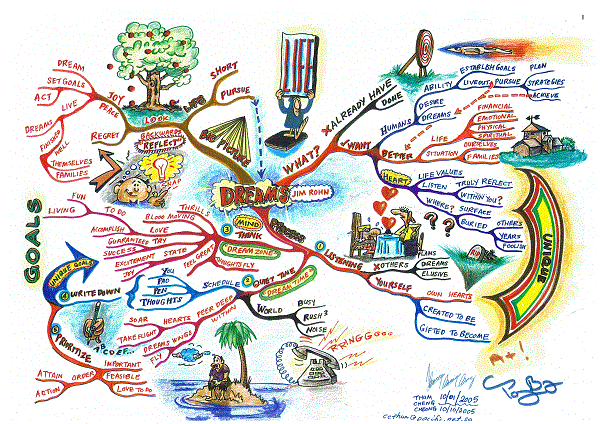
How can we know
the general direction we should follow? How can anyone who has not
dreamed the whole route begin to locate himself on such a map? When
Joseph, or any of the other men, began to draw a hunting map, he had
first to find his way. He did this by recognizing features, by fixing
points of reference, and then, once he was oriented to the familiar
and to the scale or manner in which the familiar was reproduced, he
could begin to add his own layers of detailed information.
How
can one design? How can we know the general direction we should
follow? These words quoted above touch most profoundly what the
act of design is in a remarkable manner. The text that they come
from, their context, is reproduced below: it embellishes the
understanding of this subtle and complex matter.
Sibusiso Mthembu in front of his map to Heaven.
Most attempts to
describe the process of design become too prescriptive, or too
vaguely mystical, leaving one concerned with the directions defined
as a precisely rational method, (Heath Method in Architecture
Wiley & Sons UK 1984 ); or as the seemingly fanciful vagaries of
things strangely abstract, (Kandinsky Concerning the Spiritual in
Art Munich 1911; translated 1914). Here, in these words as
remembered by Hugh Brody, there is a marvellous amalgam of both
circumstances, the mystic and factual, that engages both the feeling
body and the thinking mind as an acting, responsive whole.
In summary:
When one
starts to design: begin by finding the way; recognizing features;
fixing points of reference; then, once familiar with scale and manner
of reproduction, with this understanding of the realization, add
other layers of detailed information.
Hugh Brody
One
is reluctant to add more, other than to note the particular context
of these words that expands the relevance of the message; gives it
depth and coherence. The words are in Hugh Brody’s Maps and
Dreams, Jill Norman & Hobhouse, London, 1981, a study of the
Indians on the British Columbia frontier. Pages 44 to 48 are
reproduced here in full, for clarification of a matter that is truly
difficult to put into words. The point is that the experience is a
dreaming of a hunt, rather than the hunt for the clever, dream
project; the search for something adequately fanciful, different, and
eye-catchingly startling, that can declare one’s brilliance. There
is something subtly different embodied here; something rich,
modest, and personally meaningful; something true, with depth, that
seeks nothing like the ‘bold, creative, bespoke self-expression’
that art and architecture has become - (c.f. Gehry, Hadid).# Silence
is important; and a quality of intimate being too: goodness; both
matters that are alien to our ‘clever, self-important’ world
today.
For those who do
not understand, hunting and life itself are restricted and difficult.
So the people must be told everything, and taught all that they need,
in order to withstand the incursions presently being made into their
way of life, their land, and into their very dreams.
#
One
could add Mies van der Rohe too – see Alex Beam’s Broken Glass
Random House, NY, 2020. The Farnsworth house stands as an example
of heroic modernism, still idealised today in spite of its obvious
failings. One is left wondering just what we are now involved in with
such ‘disastrous’ projects remaining as gleaming icons of our
ambitions, listed by the New York Times as one of the 25 most
influential post-war buildings. The house was built on a flood plain,
with one door and one set of windows; the roof leaked; it was hot in
summer and cold in winter; the travertine that cost a sixth of the
budget, heaved with the weather . . . etc., etc. - see the book. Yet
it is still one of the best, one of the most influential houses in
the USA; indeed, in the world. What is happening?
The Post-war icon.
The challenge of modernism?
MAPS
AND DREAMS
pp44-48
There was a brief
silence made awkward by expectancy, though an awkward pause is a very
rare thing among people who accept that there is no need to escape
from silence, no need to use words as a way to avoid one another, no
need to obscure the real.
Atsin broke this
silence. He spoke at first of the research. “I bet some guys make
big maps. Lots of work, these maps. Joseph, he sure is happy is happy
to see maps.”
Silence again. Then
Robert continued: “Yeah, lots of maps. All over this country we
hunt. Fish too. Trapping places. Nobody knows that. White men don't
know that.”
Then Jimmy spoke:
"Indian guys, old-timers, they make maps too."
With these words,
the men introduced their theme. The tone was friendly, but the words
were spoken with intensity and firmness. The men seemed apprehensive,
as if anxious to be very clearly understood - though nothing said so
far required such concern. Once again, it is impossible to render
verbatim all that they eventually said. I had no tape recorder and
memory is imperfect. But even a verbatim account would fail to do
justice to their meaning. Here, then, in summaries and glimpses, is
what the men had in mind to say.
Some old-timers, men
who became famous for their powers and skills, had been great
dreamers. Hunters and dreamers. They did not hunt as most people now
do. They did not seek uncertainly for the trails of animals whose
movements we can only guess at. No, they located their prey in
dreams, found their trails, and made dream-kills. Then, the next day,
or a few days later, whenever it seemed auspicious to do so, they
could go out, find the trail, re-encounter the animal, and collect
the kill.
Maybe, said Atsin,
you think this is all nonsense, just so much bullshit. Maybe you
don't think this power is possible. Few people understand. The
old-timers who were strong dreamers knew many things that are not
easy to understand. People - white people, young people - yes, they
laugh at such skills. But they do not know. The Indians around this
country know a lot about power. In fact, everyone has had some
experience of it. The fact that dream-hunting works has been proved
many times.
A few years ago a
hunter dreamed a cow moose kill. A fine, fat cow. He was so pleased
with the animal, so delighted to make this dream-kill, that he marked
the animal's hooves. Now he would be sure to recognize it when he
went on the coming hunt. The next day, when he went out into the
bush, he quickly found the dream-trail. He followed it, and came to a
large cow moose. Sure enough, the hooves bore his marks. Everyone saw
them. All the men around the fire had been told about the marks, and
everyone on the Reserve had come to look at those hooves when the
animal was butchered and brought into the people's homes.
And not only that
fat cow moose – many such instances are known to the people, whose
marks on the animal or other indications show that there was no
mistaking, no doubts about the efficacy of such dreams. Do you think
this is all lies? No, this is power they had, something they knew how
to use. This was their way of doing things, the right way. They
understood, those old-timers, just where all the animals came from.
The trails converge, and if you were a very strong dreamer you could
discover this, and see the source of trails, the origin of game.
Dreaming revealed them. Good hunting depended upon such knowledge.
Today it is hard to
find men who can dream this way. There are too many problems. Too
much drinking. Too little respect. People are not good enough now.
Maybe there will again be strong dreamers when these problems are
overcome. Then more maps will be made. New maps.
Oh yes, Indians made
maps. You would not take any notice of them. You might say such maps
are crazy. But maybe the Indians would say that is what your maps
are: the same thing. Different maps from different people - different
ways. Old-timers made maps of trails, ornamented them with lots of
fancy. The good people.
None of this is easy
to understand. But good men, the really good men, could dream of more
than animals. Sometimes they heaven and its trails. Those trails are
hard to see, and few men have had such dreams. Even if they could see
dream-trails to heaven, it is hard to explain them. You draw maps of
the land, show everyone go. You explain the hills, the rivers, the
trails from here to Hudson Hope, the roads. Maybe you make maps of
where the hunters go and where the fish can be caught. That is not
easy. But easier, for sure, than drawing out the trails to heaven.
You may laugh at these the trails to heaven, but they were done by
the good men who had the heaven dream, who wanted to tell the truth.
They worked hard on their truth.
Atsin had done most
of the talking this far. The others interjected a few words and
comments, agreeing or elaborating a little. Jimmy told about the cow
moose with marked hooves. All of them offered some comparisons
between their own and others' maps. And the men's eyes never ceased
to remain fixed on me: were they being understood? Disregarded?
Thought ridiculous? They had chosen this moment for these
explanations, yet no one was entirely secure in it. Several times,
Atsin paused and waited, perhaps to give himself a chance to sense or
absorb the reaction to his words. These were intense but not tense
hiatuses. Everyone was reassuring himself that his seriousness was
being recognized. That was all they needed to continue.
The longest of these
pauses might have lasted as much as five minutes. During it the fire
was rebuilt. It seemed possible, for moments, that they had finished,
and that their attention was now returning to trout, camp, and the
hunt. But the atmosphere altered, and Jimmy quite abruptly took over
where Atsin had left off.
The few good men who
had the heaven dream were like the Fathers, Catholic priests, men who
devoted themselves others to helping with that essential knowledge to
which ordinary women have limited access. (Roman Catholic priests
have drifted in and out of the lives of all the region's Indians,
leaving behind fragments of their knowledge and somewhat rarefied and
idealized versions of what they had to preach.) Most important of
all, a strong dreamer can tell others how to get to heaven. We all
have need of the trail, or a complex of trails, but, unlike other
important trails, the way to heaven will have been seen in dreams
that only a few, special individuals have had. Maps of heaven are
thus important. And they must be good, complete maps. Heaven is
reached only by careful avoidance of the wrong trails. These must
also be shown so that the traveller can recognize and avoid them.
How can we know the
general direction we should follow? How can anyone who has not
dreamed the whole route begin to locate himself on such a map? When
Joseph, or any of the other men, began to draw a hunting map, he had
first to find his way. He did this by recognizing features, by fixing
points of reference, and then, once he was oriented to the familiar
and to the scale or manner in which the familiar was reproduced, he
could begin to add his own layers of detailed information. But how
can anyone begin to find a way on a map of trails to heaven, across a
terrain that ordinary hunters do not experience in everyday
activities or even in their dream-hunts?
The route to heaven
is not wholly unfamiliar, however. As it happens, heaven is to one
side of, and at the same level as, the point where the trails to
animals all meet. Many men know where this point is, or at least some
of its approach trails, from their own hunting dreams. Hunters can in
this way find a basic reference, and once they realize that heaven is
in a particular relation to this far more familiar centre, the map as
a whole can be read. If this is not enough, a person can take a map
with him; some old-timers who made or who were given maps of the
trails to heaven choose to have a map buried with them. They can thus
remind themselves which ways to travel if the actual experience of
the trail proves to be too confusing. Others are given a corner of a
map that will help reveal the trail to them. And even those who do
not have any powerful dreams are shown the best maps of the
route to heaven. The discoveries of the very few most powerful
dreamers - and some of the dreamers have been women - are
periodically made available to everyone.
The person who
wishes to dream must take great care, even if he dreams only of the
hunt. He must lie in the correct orientation, with his head towards
the rising sun. There should be no ordinary trails, no human
pathways, between his pillow and the bush. These would be confusing
to the self that travels in dreams towards important and unfamiliar
trails which can lead to a kill. Not much of this can be mapped -
only the trail to heaven has been drawn up. There has been no
equivalent need to make maps to share other in information.
Sometime, said Jimmy
Wolf, you will see one of these maps. There are some of them around.
Then the competence and strength of the old-timers who drew them will
be unquestioned. Different trails can be explained, and heaven can be
located on them. Yes, they were pretty smart, the men who drew them.
Smarter than any white man in these parts and smarter than Indians of
today. Perhaps, said Atsin, in the future there will be men good
enough to make new maps of heaven - but not just now. There will be
changes, he added, and the people will come once again to understand
the things that Atsin's father had tried to teach him. In any case,
he said, the older men are now trying to explain the powers and
dreams of old-timers to the young, indeed to all those who have not
been raised with these spiritual riches. For those who do not
understand, hunting and life itself are restricted and difficult. So
the people must be told everything, and taught all that they need, in
order to withstand the incursions presently being made into their way
of life, their land, and into their very dreams.

A map of Heaven made by an Athapaskan tribe in northeastern British
Columbia.
A map of paradise
POSTSCRIPT
While the process of design can be spoken of as noted above - when one starts to design: begin by finding the way; recognizing features; fixing points of reference; then, once familiar with scale and manner of reproduction, with this understanding of the realization, add other layers of detailed information - there is still something missing: how? Something more is needed; something more specific about the process, the experience, is required.
Hugh Brody's text helps here again where he describes the planning for the hunt; the decision-making process. The words are astonishing in their clarity and precision, and hold a subtle relevance to the process of design; to explaining it; to capturing some sense of the involvement necessary without destroying its qualities with the rigorous, rational analysis we see in Heath's text.
MAPS AND DREAMS
pp36-37
. . . the twin spectres of hunger and homelessness, whose fearsome
imminence is escaped only in the bright sunlight of planning.
Planners consider many possibilities, weigh methods, review timing,
and at least seek to deduce what is best. To this end they advocate
reason and temperance, and, most important, they are thrifty and
save. These ideas and dispositions, elevated to an ideal in the
economics of nineteenth-century and secular puritanism, live on in
the reaction of industrial society to hunters - and in the average
Canadian’s reaction to Indians. And a reaction of this kind means
that a person even if inclined to be sympathetic to hunters and
hunting, has immense difficulty in understanding what planning means
for hunters of the North.
Joseph and his
family float possibilities. “Maybe we should go to Copper Creek.
Bet you lots of moose up there.” Or, "Could be caribou right
now near Black Flats.” Or, “I bet you no deer this time down on
the Reserve...” Somehow a general area is selected from a gossamer
of possibilities, and from an accumulation of remarks comes something
rather like a consensus. No, that is not really it: rather, a sort of
prediction, a combined sense of where we might go “tomorrow."
Yet the hunt will not have been planned, nor any preparations
started, and apparently no one is committed to going. Moreover, the
floating conversation will have alighted on several irreconcilable
possibilities, or have given rise to quasi-predictions. It is as if
the predictions are about other people – or are not quite serious.
Although the mood is still one of wait and see, at the end of the
day, at the close of much slow and gentle talk about this and that, a
strong feeling has arisen about the morning: we shall go to
Bluestone, maybe as far as the cross. We shall look for trout as well
as moose. A number of individuals agree that they will go. But come
morning, nothing is ready. No one has made any practical, formal
plans. As often as not — indeed, more often than not - something
quite new has drifted into conversations, other predictions have been
tentatively reached, a new consensus appears to be forming often
seems, everyone has changed his mind.
The way to understand this kind of decision making, as also to live
by and even share it, is to recognize that some of the most important
variables are subtle, elusive, and extremely hard or impossible to
assess with finality. The Athapaskan hunter will move in a direction
and at a time that are determined by a sense of weather (to indicate
a variable that is easily grasped if all too easily oversimplified by
the one word) and by a sense of rightness. He will also have ideas
about animal movement, his own and others' patterns of land use ...
But already the nature of the hunter's decision making is being
misrepresented by this kind of listing. To disconnect the variables,
to compartmentalize the thinking, is to fail to acknowledge its
sophistication and completeness. He considers variables as a
composite, in parallel, and with the help of a blending of the
metaphysical and the obviously pragmatic. To make a good, wise,
sensible hunting choice is to accept the interconnection of all
possible factors, and avoids the mistake of seeking rationally to
focus on any one consideration that is held as primary. What is more,
the decision is taken in the doing: there is no step or pause between
theory and practice. As a consequence, the decision - like the action
from which it is inseparable - is always alterable (and therefore may
not properly even be termed a decision). The hunter moves in a chosen
direction; but, highly sensitive to so many shifting considerations,
he is always ready to change his directions.
Planning, as other
cultures understand the notion, is at odds with this kind of
sensitivity and would confound such flexibility. The hunter, alive to
constant movements of nature, spirits, and human moods, maintains a
way of doing things that repudiates a firm plan and any precise or
specified understanding with others of what he is going to do. His
course of action is not, must not be, a matter of predetermination.
If a plan constitutes a decision about the right procedure or action,
and the decision is congruent with the action, then there is no space
left for a "plan," only for a bundle of open-ended and
nonrational possibilities. Activity enters so far into this kind of
planning as to undermine any so-called plans.
All this is by way
of context or background for the seemingly straightforward proposal
that we should set out the next morning.
Using Brody's words:
Designing involves pondering a gossamer of possibilities; alighting
on several irreconcilable possibilities that give rise to
quasi-predictions; no one is committed: something quite new might
drift into conversations, other predictions tentatively reached; a
new consensus might appear to be forming. Some of the most important
variables are subtle, elusive, and extremely hard or impossible to
assess with finality, but they are gauged by a sense of rightness.
Variables are considered as a composite, in parallel, and with the
help of a blending of the metaphysical and the obviously pragmatic.
The mistake of seeking rationally to focus on any one consideration
that is held as primary has to be avoided. The decision - like the
action from which it is inseparable - is always alterable, remaining
highly sensitive to so many shifting considerations. One has to be
always ready to change a decision about the right procedure or
action. There is no space left for a "plan," only for a
bundle of open-ended and nonrational possibilities.
Is this the dreaming of the hunt? Even the good men struggled with explanations:
Those trails are hard to see, and few men have had such dreams. Even if they could see dream-trails to heaven, it is hard to explain them.
We'll have to learn to stop hunting the dream.
“Journey of the Dead to Dhuwa”,
Land of the Dead for the Jiridja
Australians, by Binyinyuwuy, 1948.